
Modern rail infrastructure relies on a huge amount of equipment operating reliably behind the scenes.
From signalling systems to power distribution equipment, much of this infrastructure needs to be protected from harsh environmental conditions while remaining accessible for installation and maintenance.
That’s where Relocatable Equipment Buildings (REBs) play a critical role.
Used across rail infrastructure projects, Relocatable Equipment Buildings provide secure, controlled environments for housing signalling, power, telecoms, and control equipment trackside. Their design, layout, and testing can have a significant impact on reliability, maintainability, and project delivery.
What Is a REB?
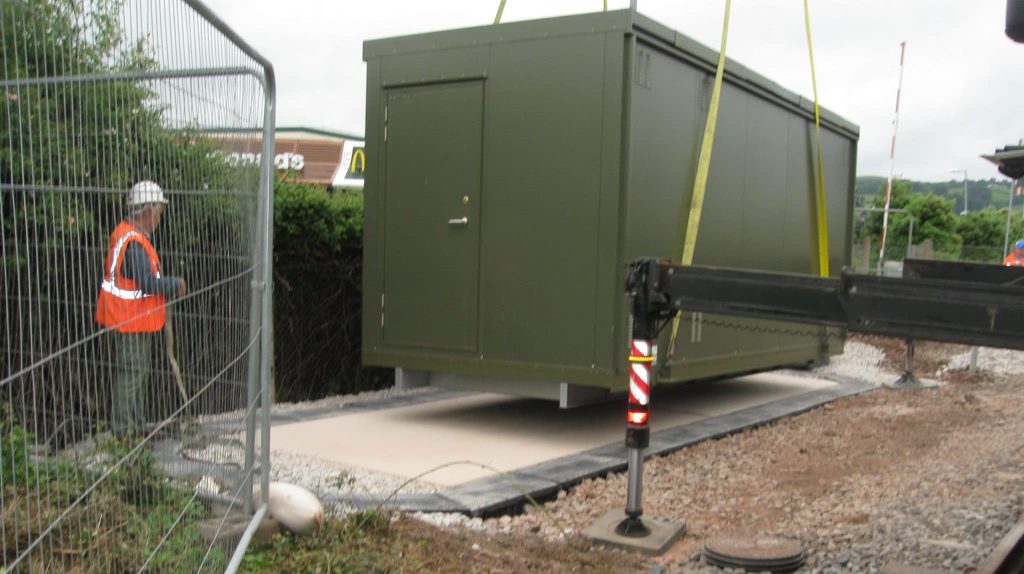
A Relocatable Equipment Building (REBs) is a kind of railway specific industrial quality portable cabin. Essentially a controlled environment designed to house the equipment that keeps sections of the railway operating safely and reliably.
They are relocatable, in that they are manufactured complete with lifting eyes and can be moved from one location to another for installation and fit-out purposes using a crane or HIAB. However, once delivered onto their concrete base on site they become a fixed asset and remain in position for their full service life.
What Are REBs Used For in Rail Infrastructure?
Relocatable Equipment Buildings are used across railway infrastructure projects to house a wide range of operational equipment.
Their primary role is to provide a secure and environmentally controlled space for systems that support signalling, power distribution, telecommunications, and railway operations.
Depending on the project, an Relocatable Equipment Building REB may contain:
- Signalling systems
- Interlocking equipment
- Relay racks
- Axle counter systems
- Track circuit interfaces
- Power distribution equipment
- Battery systems and chargers
- Telecoms and networking equipment
- SCADA interfaces
- Level crossing control systems
- Environmental monitoring systems
Because modern railway systems rely heavily on sensitive electronics and data communication, maintaining stable operating conditions inside the Relocatable Equipment Building is critical for long-term reliability.
What Equipment Is Typically Installed Inside an REB?
The exact equipment inside an Relocatable Equipment Building
depends on the route, infrastructure design, and project requirements.
However, most Relocatable Equipment Buildings typically contain a combination of signalling, power, telecoms, and environmental systems.
Signalling Equipment
Signalling equipment is often the primary function of the building and can include:
- Relay racks
- SSI or CBI signalling systems
- Train detection systems
- Axle counter equipment
- Signal control modules
- Event recorders
Power Distribution Equipment
Many REBs also act as local railway power hubs.
This equipment may include:
- Distribution boards
- UPS systems
- Battery banks
- Transformers
- Functional Supply Point (FSP) equipment
- Switchgear assemblies
- Earthing and bonding systems
Telecommunications & Networking
Modern rail infrastructure depends heavily on communications systems and remote monitoring.
Relocatable Equipment Building REBs may therefore contain:
- Fibre optic termination panels
- Telecoms racks
- Network switches
- SCADA interfaces
- Remote condition monitoring systems
Environmental & Safety Systems
Because railway electronics are highly sensitive, REBs also include systems designed to maintain safe operating conditions, such as:
- HVAC or climate control systems
- Fire detection systems
- Intruder alarms
- Emergency lighting
- Surge protection
- Moisture and condensation control
Good cable management is also a major part of REB design, helping improve maintainability, fault finding, and long-term reliability.
Why Are Relocatable Equipment Buildings Used Instead of Traditional Buildings?
One of the biggest advantages of an REB is that most of the work can be completed off-site before the building arrives trackside.
The REB can be:
- Designed
- Manufactured
- Wired
- Fitted out
- Tested
…within a controlled factory environment before delivery to site.
Once delivered, the building is typically craned onto prepared foundations and connected to railway services, significantly reducing on-site installation time.
This approach offers several advantages over traditional brick-built equipment rooms:
Faster Installation
Rail possessions and access windows are often limited. Off-site manufacturing helps reduce installation time and minimise disruption to railway operations.
Better Quality Control
Factory-built environments allow for tighter quality control, improved testing, and more consistent workmanship than exposed construction sites.
Reduced Time Working Trackside
Less on-site work means:
- fewer people working near operational railway infrastructure
- shorter possessions
- reduced safety exposure
- lower operational disruption
Easier Standardisation
Relocatable Equipment Building support repeatable designs and standard layouts, helping simplify maintenance and improve consistency across multiple projects.
Greater Flexibility
REBs can potentially be repurposed, upgraded, or relocated later in the asset lifecycle if infrastructure requirements change.
Why Are REBs Used Instead of Traditional Location Cases?
Where a site would require 5 or 6 individual location cases to house the necessary equipment it is often simpler and more efficient to install a small REB. A single large concrete base can be easier from a civils perspective than having to install more complex cable routes, access paths and the multiple concrete bases that are required by a large suite of location cases.
In addition, traditional location cases provide no environmental controls other than anti-condensation heaters. This makes them unsuitable to house the more modern and complex electronic systems that are becoming ever more commonplace on the Uks advanced rail network. REBs provide a stable air-conditioned environment that is ideal for these systems.
What Are The Key Design Considerations for Railway REBs
There are multiple design considerations when specifying an REB and these can be broadly split into external and internal considerations.
External design considerations include:
- Land required for the REB to be located – including the necessary clearances to be able to deliver the REB via crane of HIAB.
- Access arrangements including footpaths and any security fencing.
- Cable routes to enable the REB to be connected to the rest of the railway.
- Power supply to REB
- Surrounding environment – external colour options
Internal design considerations include:
- HVAC requirements and internal air-flow
- Equipment layout
- Cable entry points
- Internal lighting
- Electro-Magnetic Compatibility for sensitive equipment
- Internal Walkways and access and egress points.
What Environmental Conditions Do Relocatable Equipment Building Need to Withstand?
REBs are designed to protect critical railway equipment in some of the harshest operational environments on the network.
They may be exposed to:
- High summer temperatures
- Freezing winter conditions
- Rapid temperature fluctuations
- Heat build-up from internal equipment
This is why many REBs include HVAC or climate control systems to maintain stable operating temperatures for signalling and power equipment.
Moisture & Condensation
Moisture is one of the biggest threats to electrical equipment.
Dust & Airborne Contamination
Over time, contamination can affect electrical performance and cooling systems if not properly controlled.
That’s why filtered ventilation and carefully managed airflow are important considerations in REB design.
Vibration
Even though the building itself is static, equipment inside may still be exposed to:
- Ground vibration from passing trains
- Mechanical vibration from nearby infrastructure
- Long-term structural movement
Internal equipment mounting and cable management therefore need to be designed with durability in mind.
Wind Loading
Some Relocatable Equipment Building are installed in extremely exposed areas such as:
- Coastal routes
- Open countryside
- Elevated embankments
The structure must therefore withstand high wind loads while protecting internal systems from water ingress and structural stress.
Electrical & EMC Conditions
Railway environments create unique electrical challenges, including:
- Electrical surges
- Induced voltages
- Electromagnetic interference (EMC)
- Earthing and bonding requirements
Relocatable Equipment Building designs need to ensure sensitive signalling and telecoms equipment remains protected and compliant.
Fire Safety
Because REBs often house critical operational systems, fire protection is also important.
Why It Matters
Railway signalling and power systems are expected to operate continuously in all weather conditions.
A failure caused by heat, moisture, contamination, or environmental damage can lead to:
- Delays
- Faults
- Maintenance disruption
- Safety risks
That’s why Relocatable Equipment Building REBs are engineered not just as buildings, but as controlled environments specifically designed for long-term railway infrastructure reliability.
That why we typically manufacture REBs to railway specifications such as BR1615D, with full factory testing completed before deployment onto site.z
What Testing is completed before Relocatable Equipment Building delivered?
Before delivery to site, REBs typically undergo extensive inspection and testing.
From a building point of view all REBs come with:
- Electrical Installation Certification (EIC)
- Fire alarm system test certificate and O&M documentation
- Intruder alarm system test certificate and O&M documentation
- HVAC system test certificate and O&M documentationv
In addition, once fitted out the signalling and/or power distribution equipment within an REB can be tested prior to dispatch and depending on the supplier and the customer requirements this can include:
- Module 3A Test and Inspection
- Module 3B Test and Inspection
- Module 3C Test and Inspection
- BS7671 Test and Inspection
Why Layout and Cable Routing Matter
If the internal layout of an REB is wrong multiple issues can arise such as:
- restricted equipment access
- Lighting shadows
- Hot / cold spots
- Difficult to terminate external cables
- Restricted access to equipment
- Poor maintainability
Even where equipment has been laid out properly the routing of cables is still important to avoid the following issues:
- Over capacity of cable conduits
- Excessively long cable runs – which can cause issues with sensitive electronic equipment
- Conflicts between electrically clean and dirty wiring runs
- Poor earthing
- Difficult on-site terminations and ongoing maintainability
What does “first-fit” mean in practice?
Completion of “First-fit” is often the first major milestone in and REB delivery programme. Depending on the type of equipment being installed this can often take up to 50% of the programme duration as any mistakes made at this stage can be costly in terms of both budget and time. The “first-fit” entails the following works:
- Inspection and Test of the empty REB – including connecting the REB to local power and verifying that all electrical installations and systems are operating correctly and are as specified by the client.
- Preparation for Installation: including installation of floor and wall protection as required.
- Mechanical fit-out: building and securing all racking to the floor and walls and installing any equipment cubicles.
- Cable Containment fit out: including inter-racking and overhead cable routes.
What do clients typically care most about?
The biggest concerns for clients when ordering REBs are:
- Price: both in terms of the purchase price but also in terms of risk as often the landing of a REB on its base will be a critical project milestone.
- Timescale: these need to be realistic, completely reliable and as efficient as possible.
- Quality: A good high-quality build makes on site installation and testing quicker and easier.
- Delivery: REBs can be up to 12 metres long and weigh over 8 tonnes. Therefore, having an experienced supplier who can help organise a safe and professional delivery of the REB is key.
- Maintainability: a well-designed REB will provide an environment that is not only good for the equipment but is good for the maintainer ensuring a comfortable, well-lit, and logically laid out building.
Relocatable Equipment Buildings play a vital role in modern rail infrastructure projects.
By providing controlled environments for signalling, power, telecoms, and operational systems, REBs help improve reliability, reduce installation risk, and support more efficient project delivery.
As railway infrastructure continues to modernise, the demand for modular, factory-built solutions is likely to continue growing — particularly where quality, maintainability, and reduced time on track are key project requirements.
For rail projects, REBs are far more than portable buildings. They are critical operational infrastructure designed specifically for the long-term demands of the railway environment.
Looking for Railway REB Solutions?
At RSP Rail, we design, manufacture, and support high-quality Relocatable Equipment Buildings (REBs) for rail infrastructure projects across the UK.
Our capabilities include:
- REB design and manufacture
- Signalling and power integration
- First-fit and factory testing
- Functional Supply Points (FSPs)
- Rail power distribution equipment
- Trackside infrastructure solutions
Explore our related services and products:
- Relocatable Equipment Buildings (REBs)
- Functional Supply Points (FSPs)
- Rail Power & Distribution Solutions
- Contact RSP Rail
Or speak to our team about your next rail infrastructure project.