
Rail Cubicles / Enclosures
RSP have a wealth of knowledge and experience in designing and manufacturing rail cubicles/enclosure to fit any requirement you may have. We can manufacture the rail cubicles from your specific requirements or work with you to design the rail cubicle to meet your exact business needs.

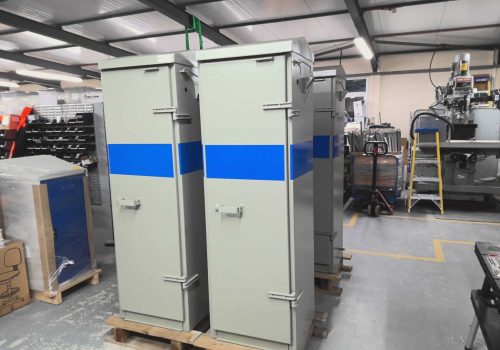

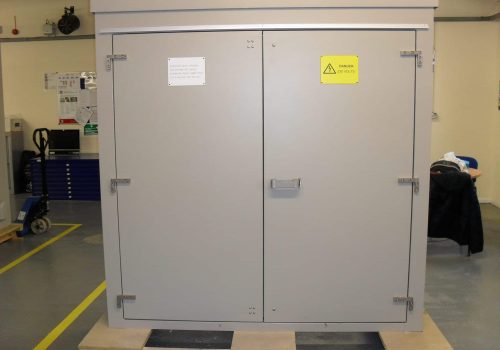
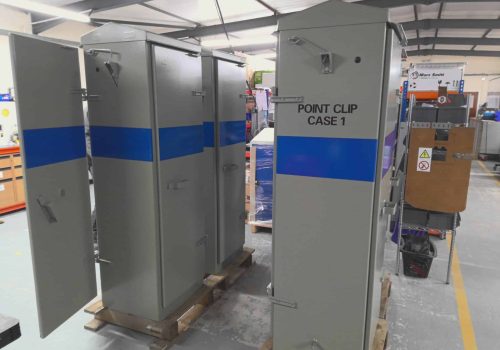


Bespoke Rail Cubicles & Enclosures Range
These rail cubicles can be manufactured in stainless steel, mild steel or GRP and can be designed and tailored to meet project specific requirements in line with budgets and timescales. Our in-house team of electrical designers use 3D modelling software to produce 3D designs and can manufacture rail cubicles to meet any customer bespoke specifications, from Pump Control Cubicles to Rail Sub Distribution Cubicles, Transformer Cubicles and more.
RSP has the knowledge and capabilities, working from our modern factory in Saltash, Cornwall, we can design, manufacture and test complete rail housing solutions, which offer our clients and its project the increased safety of off-site manufacturing.
On this page;
Rail Feeder Pillars & Power Pillars — UK Manufacturer
Our rail feeder pillars are designed and manufactured at our modern facility in Saltash, Cornwall, and fully tested to meet standards BS7671 and BSEN 60439 before leaving our factory. Available in mild steel, stainless steel or GRP, each unit can be supplied fully equipped to your specification — including lineside transformers, switchgear, cubicle lighting and anti-condensation heating. Units are available with or without a plinth, which can significantly reduce time and cost spent on groundworks during installation.
Rail feeder pillars provide a safe and reliable method of trackside power distribution across railway infrastructure. These robust electrical enclosures act as a local electrical hub, receiving power from the main supply and distributing it to multiple railway systems simultaneously.
Installed trackside, feeder pillars allow power to be distributed efficiently to nearby assets while ensuring all electrical equipment remains protected from weather, physical damage and unauthorised access. By centralising electrical distribution at a single point, they reduce the need for long cable runs and give engineers a convenient, safe location to isolate individual circuits during maintenance or fault investigation — minimising disruption to the wider network.
Typical applications for rail feeder pillars include:
- Platform and station lighting supplies
- Signalling power distribution
- Telecoms and communications equipment
- Points heating systems
- Level crossing power supplies
- Lineside infrastructure and access lighting
Standard build options:
| Feature | Options Available |
|---|---|
| Material | Mild steel, stainless steel, GRP |
| Finish | Polyester powder coat, galvanised, RAL colour match |
| Standards | BS7671, BSEN 60439 |
| Internal equipment | Switchgear, lineside transformers, cubicle lighting, anti-condensation heating |
| Plinth | With or without, customer-specified height |
| Supply voltage | Single or three phase, to project specification |
| Access | Single or double door, lockable, with or without ventilation louvres |
| Testing | Factory Acceptance Testing (FAT) completed prior to delivery |
All feeder pillars are designed and tailored to meet your project-specific requirements, budgets and programme timescales. Our in-house electrical design team use 3D modelling software to produce detailed designs before manufacture begins, giving you full visibility of the finished product before it’s built.
Frequently Asked Questions — Rail Cubicles & Feeder Pillars
What is a rail feeder pillar?
A rail feeder pillar (also called a power pillar) is a weatherproof electrical enclosure installed trackside that receives power from a main supply and distributes it to multiple railway systems. It acts as a local hub for electrical distribution, protecting switchgear and equipment from the rail environment while giving engineers safe access for maintenance and isolation.
What materials are RSP’s rail cubicles available in?
Our rail cubicles and feeder pillars are available in mild steel, stainless steel and GRP (Glass Reinforced Plastic). The choice of material depends on your project environment, budget and longevity requirements. GRP is particularly suited to coastal or high-corrosion environments, while stainless steel is preferred where a longer service life and minimal maintenance are priorities.
Are your rail cubicles and feeder pillars Network Rail approved?
RSP designs and manufactures rail cubicles to Network Rail standards. Our sub distribution cubicles have been installed at major Network Rail sites including Paddington Station. We are happy to discuss specific project standards and approval requirements with your team at enquiry stage.
Can you design a bespoke rail enclosure to our specification?
Yes. All of our rail cubicles and feeder pillars are designed and manufactured to your exact requirements. Our in-house electrical design team uses 3D modelling software to produce detailed designs before manufacture begins. We work with you from initial brief through to Factory Acceptance Testing (FAT) and delivery.
What is the difference between a feeder pillar and a sub distribution cubicle?
A feeder pillar typically receives power directly from the DNO or traction supply and distributes it to nearby trackside assets. A sub-distribution cubicle sits further downstream — it takes an incoming feed from a primary supply point and distributes it across multiple secondary circuits, such as signalling, telecoms and lineside infrastructure. Both can be designed and manufactured by RSP to project specification.
What standards do your feeder pillars meet?
Our rail feeder pillars are manufactured and tested to BS7671 (IET Wiring Regulations) and BSEN 60439 (Low Voltage Switchgear and Control gear Assemblies). Additional project-specific standards can be accommodated — please discuss your requirements with our team at enquiry stage.
Need pricing or technical details on a specific configuration?
Pump Control Cubicles
The rail Pump Control Cubicle is designed to provide power to and house the railway pump control panel along with its own domestic supply for lighting, power and heating.
RSP were chosen to design and build the Pump Control Cubicle as part of the Wessex SMD Framework – Epsom Station Embankment Permanent Works Project, a new Pumping Station will be installed, and a new power supply will be commissioned from the existing Network Rail DC Traction Substation.
Get a bespoke Pump Control Cubicle designed to your project spec.
Point Clip Cases – Blue Band Location Cases
A location case with a blue band typically houses Point Clip Claps and scotches.
The blue band indicates that the case is for standard, non-electrically operated point clips used in track maintenance or switching. The colour coding helps track staff to quickly identify the type of equipment inside the case.
In stock and available to order now.
Points Scotch & Branded Points Scotch
- A significantly extended lifespan through full protection against moisture and contaminants
- Improved safety and visibility in the track environment thanks to the high-visibility finish
- A PVC handle that significantly reduces breakage
- Anti-slip handle grips, reducing the risk of slips and trips during installation or removal
- Full traceability, with engraving of the date of manufacture, batch number and the owner’s company name
Why Choose Our Points Scotches
- Other companies still manufacture scotches from oak. It’s a traditional material, but not necessarily the most suitable for this application. Oak takes a long time to dry after felling, and is prone to splitting along the grain during the drying process. That weakness often shows up later as premature breakage of the machined tapers.
- Other companies’ scotches are supplied untreated, leaving the timber exposed to water, oils and grease in the track environment. Over time this can weaken the structure and increase the risk of slippage in the points face.
Rail Sub Distribution Cubicles
We have also recently designed and built a Sub Distribution Cubicle, which was installed at Paddington Station.
The cubicle was required for LV power supplies to REBs M0/95 & R0/46 and is single-sided, single-compartment assembly and manufactured from GRP, approved to Network Rail standards. The cubicle, much like a DNO Cubicle, contained incoming and outgoing supplies and contained its own domestic supply to control internal lighting, power and heating. All of our LV distribution cubicles can be designed and tailored to your project-specific requirements.
- Outdoor locations.
- Vibration.
- Moisture.
- Temperature swings.
Rail Transformer Cubicle
A rail transformer cubicle is the housing which covers and protects a power transformer, the rail cubicle can be lowered into position over the top of the transformer and fixed to the concrete plinth after the transformer has been installed.
The Transformer cubicle has its own lighting and power, along with thermostatically controlled ventilation to regulate the temperature around the transformer.
We design and manufacture rail cubicles to fit bespoke sizing and solutions.
Get a Transformer Cubicle sized and built for your installation.
Get Your Cost-effective Solution today!
Contact our experienced team for more information.
Contact Us
"*" indicates required fields